Creating a Good Sheet Music Edition – Engraving, Rhythm Notation and Accompaniment
The quality criteria that make the difference between an edition that is a joy to play and one that frustrates.
Anyone who opens a sheet music edition and starts playing will know very quickly whether it is good or not. Some editions are immediately satisfying: the notes sit comfortably under the fingers, it sounds good, and because the notation is easy to read, you can focus entirely on the music. Other editions push back – the notes have to be studied, the fingers have to contort, and even then the result sounds flat.
The difference can usually be identified before you even start practising – with a few deliberate glances at the score. For composers and arrangers who want to publish their own works, the same quality questions apply: What makes an edition readable? What makes it playable? And what makes it musically convincing?
The first two questions apply to every sheet music edition. The third – accompaniment design – is primarily relevant for arrangements, where a work is adapted for a different instrumentation than the original.
Music Engraving: Readability Starts Before the First Note
The graphic quality of a sheet music edition – the music engraving – is often the first thing that stands out. Among the most important features are the proportions: each note should occupy as much horizontal space as its rhythmic value justifies. A sixteenth note needs less space than a whole note – if both get the same amount, the eye is forced to move unnaturally and loses the sense of rhythm while still reading.
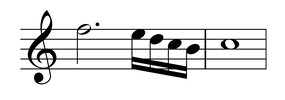
* Music example: poor proportioning of note values
Further quality criteria of the engraving: note size should be matched to the target audience and the output format – editions for children require different sizing than those for adults, and scores intended for tablet reading require different treatment than printed editions. Clear and consistent placement of tempo markings, dynamics and articulation signs is equally important.
For classical music where the notated text is fixed, quality differences between editions are usually confined to this area – the music engraving decides.
Rhythm Notation: Show the Underlying Rhythm
For transcriptions and arrangements – which make up the largest part of the sheet music market – a second quality area comes into play: the musically meaningful notation of rhythm.
Anyone transcribing a song by ear or from an audio file encounters a fundamental challenge: music is performed expressively – notes are emphasised, slightly delayed or pushed forward by minimal shifts in timing. That is interpretation. The notation should not capture that interpretation but the underlying rhythm. Only then can the player interpret the music expressively themselves. When every tiny timing nuance is written out, the performance becomes mechanical rather than musical.
In practice this means: complicated rhythms that arise from an overly literal transcription must be simplified to the actually intended basic rhythm. The same applies to very short ornamental notes – they are better notated as grace notes without their own rhythmic value.
Overly mechanical notation:

* Sheet Music example: overcomplicated rhythm
Better like this:

* Music example: simplified, readable rhythm
Accompaniment Design: Full Sound Without Excessive Difficulty
For arrangements for a single instrument – for example a piano arrangement of a song originally played by a band – a further challenge arises: one instrument must replace the richness of many, without making the edition unplayable.
The most common weakness in such arrangements is an accompaniment that is too sparse. When the harmonies are struck only once per bar, always in the same voicing, the result sounds thin – and stays the same throughout the entire piece, which destroys any sense of musical drama.
Simple harmonic accompaniment:
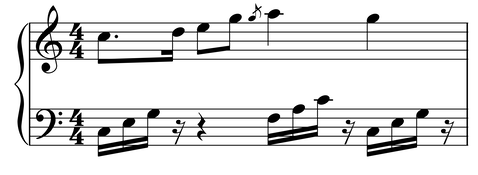
Music example: simple, sparse accompaniment
The solution lies in variation: varying density, changing note counts, considered dynamics. Through careful chord voicings and a well-constructed bass line, a rich sound can be achieved without the technical demands becoming too high.
Sounds more interesting like this:
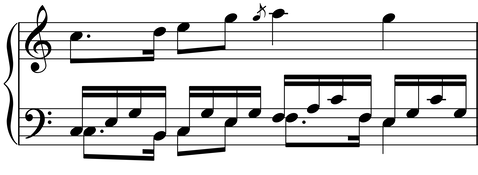
Music example: lively, varied accompaniment
Anyone reasonably familiar with the idiom of the instrument in question can create such an arrangement with manageable effort. The result is an edition that is not just correct – but genuinely enjoyable to play.
Difficulty Level: Match the Edition to the Target Audience
One dimension that is frequently overlooked: a good sheet music edition hits the right technical level for its target audience. An arrangement intended for advanced players may make different demands than one for hobby musicians or beginners – in register, chord voicings, part-writing and rhythmic complexity.
An edition that is too difficult frustrates. One that is too easy bores. Both are quality problems – regardless of how good the engraving or rhythm notation is.
The same applies to transcriptions: notating a guitar solo note-for-note creates a different edition from adapting that same solo into a playable simplification for hobby musicians. Both can be good editions – but only if the decision is made deliberately and applied consistently throughout. An edition that switches between the two levels – sometimes faithful, sometimes simplified, without any discernible principle – is harder to play than one that has made a clear commitment to its audience.
Conclusion: A Good Sheet Music Edition Is More Than an Accurate Transcription
A high-quality sheet music edition is the result of decisions on four levels: music engraving that enables readability and a comfortable reading pace, rhythm notation that makes the musical content clear rather than opaque, accompaniment design that is musically convincing without being technically overwhelming – and a difficulty level that is consistently aligned with the target audience. How these quality criteria are systematically applied in the production process is explained in the article on quality control in sheet music creation.
Composers who want to commission a professional sheet music edition to this standard will find all the information at soundnotation.com/en/sheet-music-creation.
Soundnotation supports you in the creation and utilization of musical works in sheet music form with a modern, platform-oriented approach. This allows you to tap into new markets and target groups without any effort, saving you time and money.
Start now and discover the possibilities of sound notation!
MADE IN EUROPE WITH ♥
TO SUPPORT MUSIC CREATORS
THE BEST MUSIC SERVICES
BY SONOVATIVE MUSIC GROUP
Services
Languages


© 2026 Sonovative GmbH | Legal notice | Privacy policy | Terms of service | Shipping & Delivery | Returns & Refunds | Contact
© 2023 Sonovative GmbH | Rechtliches | Impressum | Kontakt