Notating Pop Music – How Transcription Works for Modern Songs
Why standard notation reaches its limits with contemporary music – and which techniques composers and arrangers use for pop, hip-hop and electronic music.
You have produced a song – or you want to make an existing piece available as a sheet music edition. The challenge: pop music is created on computers today, with samples, loops and virtual instruments. Traditional music notation was developed for a different world. Yet it remains the standard whenever music needs to be fixed in writing – for fans, for musicians, for archives, for live performances.
The good news: there are established notation techniques developed specifically for the characteristics of modern music. This article explains what they are and when to use them.
Why Pop Music Is Difficult to Notate
Classical music was typically notated first and performed afterwards. With pop music it works the other way around: the song exists first as a recording – and notation comes after the fact. That sounds like a minor shift, but it is a fundamental difference.
Pop music thrives on elements that resist exact notation: microtones and pitch bends, the speech rhythm of rap which has no fixed metre, synthesiser sounds without a clear pitch, groove and swing that get lost in the grid of standard notation. The traditional notation system can represent this sonic world – but only with extensions and conventions that are applied deliberately.
The question is therefore not whether pop music can be notated, but what level of detail makes sense. A full score of a pop song capturing every production detail is theoretically possible but rarely practical. What matters is a notation that serves its purpose: playable, readable, expressive.
The Lead Sheet – the Standard Format for Pop Notation
For most use cases in pop music, the lead sheet is the right format. It contains melody, lyrics and chord symbols – everything a musician needs to play or accompany the song. What it leaves out: the exact accompaniment, fills, production choices.
A lead sheet is not a compromise but a deliberate decision: it gives the performer room to make their own interpretation. That is often exactly what is wanted with pop music.
For choral editions, piano arrangements or multi-part ensemble arrangements, a lead sheet alone is not sufficient – a more complete arrangement with its own voicing is needed.
Notation Techniques for Specific Sound Situations
Where standard notation reaches its limits, specialist notation devices help. The most important ones:
Rhythmic Notation for Rap and Spoken Vocals
Rap has no fixed pitches – the focus is on rhythm and speech melody. For these passages, an x notehead is used, which leaves the pitch undefined and fixes only the rhythm. This is the standard notation for spoken or rhythmically notated vocal parts.
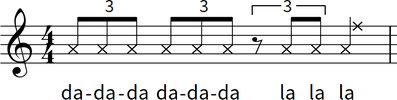
Pure sounds without pitch – breath noises, unpitched percussion, effects – are also notated with an x notehead but without a stem, to distinguish them from rhythmic speech passages.
Grace Notes for Slides, Bends and Pitch Inflections
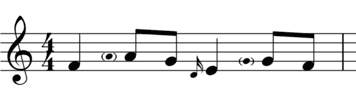
Pop music depends on expressive pitch connections: slides, glissandi, pitch bends, the brief approach from below a note. These transitions can be indicated using grace notes – small notes placed before the main note to show that the pitch is not approached directly.
Variations: a grace note with a stem indicates a clearly audible transition; a note in brackets indicates a barely audible or optional tone. This allows the individual production characteristics of a song to be reflected without cluttering the score.
Slash Notation for Open Accompaniment Parts
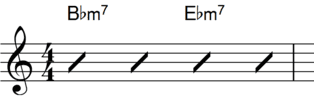
In pop pieces with an improvisatory character, it is often desirable to give the player freedom in their choice of rhythm, voicing or fill. Slash notation does exactly this: a simple slash on each beat indicates that something should be played on that beat – but how is left to the musician. This is particularly useful for guitar and piano accompaniment parts.
What Level of Detail Is Right?
This depends on the purpose of the sheet music edition. For a fan edition that allows people to play the song, a carefully prepared lead sheet with chord symbols and melody is usually sufficient. For a choral or ensemble edition, a full arrangement is needed.
Notation is also relevant for composers who want to register their works with collecting societies such as GEMA, PRS or ASCAP. A score or lead sheet serves as documentation of the work and is required for certain classification applications. More on this in the article on GEMA work classification.
What always applies: a professionally produced sheet music edition – even a deliberately simplified one – communicates quality to the buyer and makes the work playable. A poorly laid out PDF with notation errors damages the perception of the work more than an honest simplification.
Conclusion
Notating pop music is not simply a matter of transferring sound into notation – it is a creative decision about which aspects of the song to fix in writing. The techniques are there, they are well established, and they work for hip-hop, electronic music and experimental pop styles alike.
Composers who want to commission professional sheet music editions for their pop music will find all the information at soundnotation.com/en/sheet-music-creation.
How transcription from an existing audio recording works – when no notated material exists and only a finished recording is available – is covered in the article on creating sheet music from audio.
Soundnotation supports you in the creation and utilization of musical works in sheet music form with a modern, platform-oriented approach. This allows you to tap into new markets and target groups without any effort, saving you time and money.
Start now and discover the possibilities of sound notation!
MADE IN EUROPE WITH ♥
TO SUPPORT MUSIC CREATORS
THE BEST MUSIC SERVICES
BY SONOVATIVE MUSIC GROUP
Services
Languages


© 2026 Sonovative GmbH | Legal notice | Privacy policy | Terms of service | Shipping & Delivery | Returns & Refunds | Contact
© 2023 Sonovative GmbH | Rechtliches | Impressum | Kontakt